


Language, dance and music of the Garifuna
Practised In
Overview
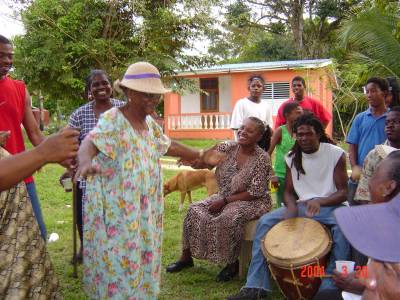
A population of mixed origin incorporating cultural elements of indigenous Caribbean and African groups, the Garifuna settled along the Atlantic coast of Central America after being forced to flee from the Caribbean island of Saint Vincent in the eighteenth century. Today, Garifuna communities mainly live in Honduras, Guatemala, Nicaragua and Belize. The Garifuna language belongs to the Arawakan group of languages and has survived centuries of discrimination and linguistic domination. It is rich in tales (úraga) originally recited during wakes or large gatherings.The melodies bring together African and Amerindian elements, and the texts are a veritable repository of the history and traditional knowledge of the Garifuna, such as cassava-growing, fishing, canoe-building and the construction of baked mud houses. There is also a considerable amount of satire in these songs, which are accompanied by various drums and dances, which the spectators may join in. These traditions are still very important to the life and survival of the Garifuna people. The elders are the ones who maintain many of the ceremonies, festivals and oral traditions. However, economic migration, discrimination and the complete absence of the Garifuna language from the school system are endangering its survival. Although the language is still widely spoken, it is now taught in only one village.
About Language
Language is a structured system of communication that consists of grammar and vocabulary. It is the primary means by which humans convey meaning, both in spoken and signed forms, and may also be conveyed through writing. Human language is characterized by its cultural and historical diversity, with significant variations observed between cultures and across time. Human languages possess the properties of productivity and displacement, which enable the creation of an infinite number of sentences, and the ability to refer to objects, events, and ideas that are not immediately present in the discourse. The use of human language relies on social convention and is acquired through learning.
Read more on WikipediaDomains
Details
- Countries
- BelizeGuatemalaHondurasNicaragua
- Inscribed
- 2008
- Register
- Representative List
- Reference
- 1