

Via Imperii
The Imperial Road — Baltic to Rome
historical~2,200 km3–4 months on foot0 places
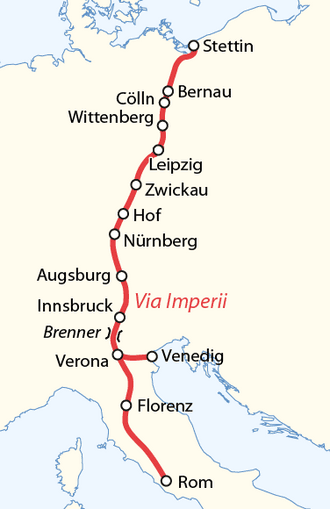
The Via Imperii ("Imperial Road") was the great medieval north-south axis of Europe, connecting the Baltic Sea at Stettin (Szczecin) with Rome via Berlin, Leipzig, Nürnberg, Augsburg, and the Brenner Pass. For centuries it served as the main artery of the Holy Roman Empire, used by emperors, pilgrims, merchants, and armies alike.
The Old Saxon Leipzig "Heliand" Manuscript Fragment (MS L): New Evidence Concerning Luther, the Poet, and Ottonian Heritage.
Timothy Blaine Price (2010)
eScholarship (California Digital Library)
2 citationsView on OpenAlex
КУЛЬТУРНИЙ ТУРИСТИЧНИЙ МАРШРУТ VIA REGIA – КОРОЛІВСЬКИЙ ШЛЯХ ВІД АТЛАНТИКИ ДО ЦЕНТРАЛЬНОЇ УКРАЇНИ
Павло Берест (2022)
Вісник науки та освіти
1 citationView on OpenAlex
Dealing With Urban Diversity: The Case Of Leipzig
Maria Budnik, Katrin Großmann, Annegret Haase (2017)
Zenodo (CERN European Organization for Nuclear Research)
1 citationView on OpenAlex
Anfänge der Stadt Leipzig
Karlheinz Blaschke (2015)
Sächsische Heimatblätter
1 citationView on OpenAlex
Data from OpenAlex, a free and open catalog of scholarly works.
The Journey
The Via Imperii linked the imperial heartlands of Germany with Rome, making it the spine of medieval European civilization. Running some 2,200 km, it crossed the Alps via the Brenner Pass — the lowest and most accessible of the main Alpine crossings — connecting Verona and the Italian plains to the German cities of Augsburg, Nürnberg, Leipzig and Berlin before reaching the Baltic at Stettin. The road intersects the Via Regia at several points, forming the great cross of medieval European highways.